A Rice guide for importers: anatomy, ageing, processing forms and grain classes, explained in the terms used on specifications and certificates of analysis.
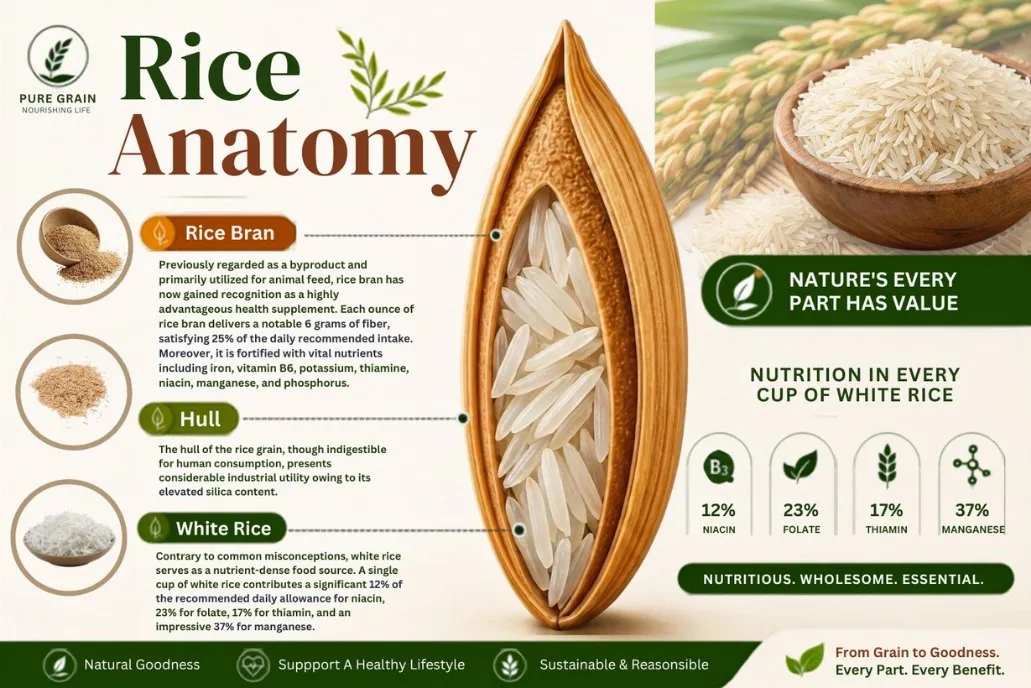
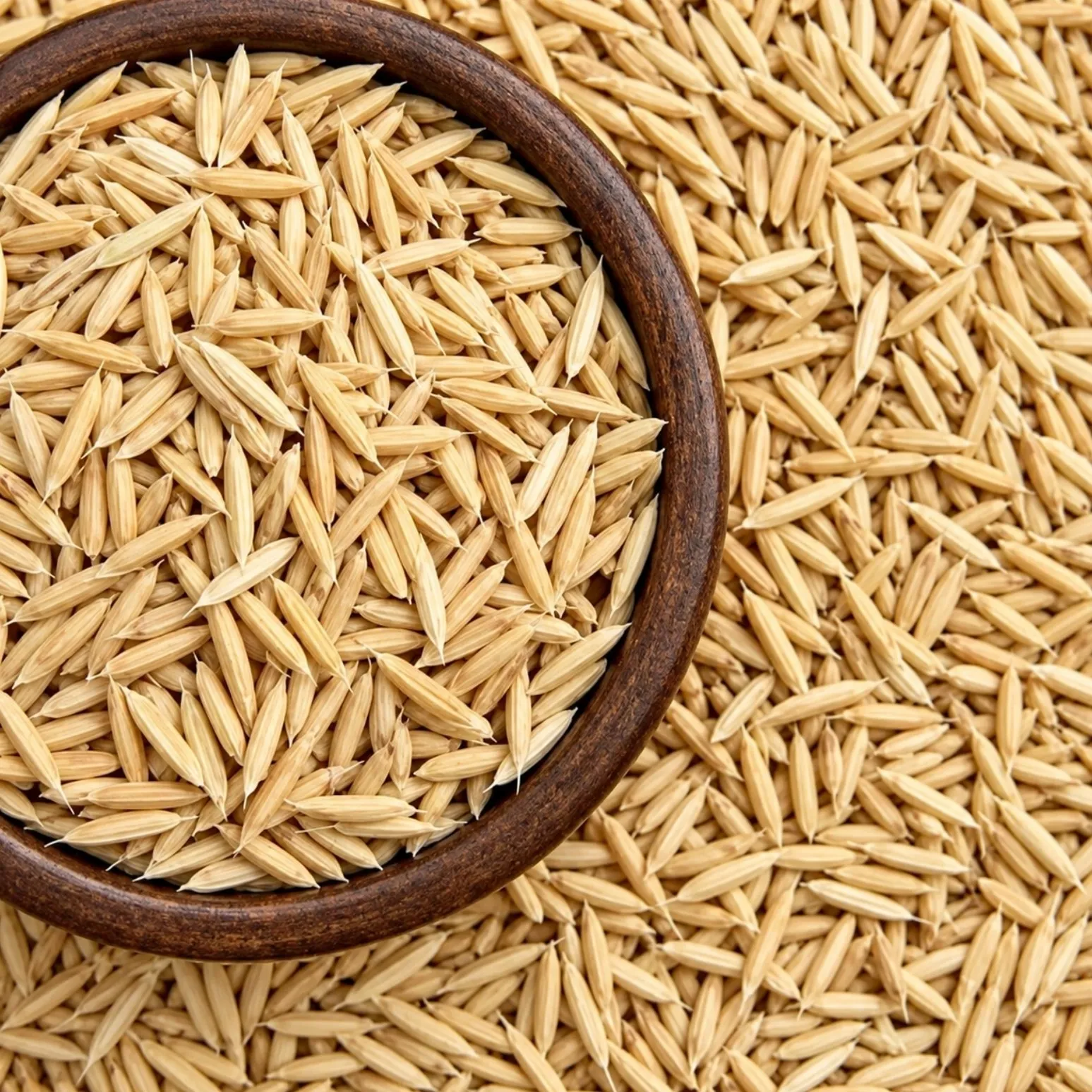
Every Rice guide starts with the grain itself. A paddy grain is a hull around a bran layer around a starchy endosperm, with a germ at the base. Milling decides how much of each you keep.
The hard outer husk, removed at husking. Indigestible for people, but its high silica content gives it industrial uses, from fuel to abrasives and building materials.
The layers under the hull that stay on brown Rice. Once treated as a by-product for animal feed, Rice bran is now valued as a health supplement: one ounce delivers around 6 grams of fibre, a quarter of the daily recommendation, plus iron, vitamin B6, potassium, thiamine, niacin, manganese and phosphorus.
The white Rice most of the world eats. Contrary to its reputation, it is nutrient dense: a cup provides roughly 12% of daily niacin, 23% folate, 17% thiamin and 37% manganese.
The embryo at the base of the kernel, rich in oils and B vitamins. Retained in brown Rice, removed with the bran in white Rice.
Terms used on specifications follow the international Rice standard published by the Codex Alimentarius.
The part of any Rice guide that matters most on a contract: five processing forms, and what each one does in the pot.
Husked, whitened and polished without heat treatment. The most delicate texture and the strongest natural aroma. Cooks soft and separate.
Paddy is steamed briefly before milling. The grain firms slightly, breaks less and takes a translucent sheen, while keeping close to the flavour of raw Rice.
Paddy soaked, steamed under pressure and dried before milling. Nutrients from the bran move into the kernel, the grain becomes harder and more resistant to breaking, and cooked Rice stays firm and separate.
A longer, hotter parboil that gives the kernel a golden tint. The Gulf's preferred form for 1121 and Super Kernel in biryani and kabsa, where firm, separate grains matter.
Husked only, bran and germ retained. Nuttier flavour, chewier texture, higher fibre. Longer cooking time and shorter shelf life than white Rice.
Not a process form but a condition: Rice held a year or more in controlled storage. Aged Basmati cooks longer, firmer and more fragrant. All our Basmati is aged before milling, four to six months minimum.
| Variety | Grain class | Average grain length |
|---|---|---|
| 1121 Basmati | Extra-long Basmati | 8.30 to 8.35 mm |
| Super Kernel Basmati | Long Basmati | 7.20 to 7.40 mm |
| D-98 Basmati (PK-385) | Long Basmati | 6.80 mm min |
| PK-386 | Long grain Non-Basmati | 6.80 mm min, steam 7.0 mm min |
| Supri Sella | Long grain Non-Basmati | 6.60 to 6.80 mm |
| C-9 (IRRI-9) | Long grain Non-Basmati | 6.60 to 6.80 mm |
| IRRI-6 | Long grain Non-Basmati | 5.80 to 6.20 mm |
Average length of the uncooked milled grain, as on each variety’s specification. Contract specifications state exact minimums per lot.
Basmati is a group of aromatic varieties grown in the Punjab region, defined by a slender kernel, a distinctive fragrance and strong elongation when cooked. 1121, Super Kernel and D-98 are the three Basmati varieties in our range.
Long grain Non-Basmati Rice, such as PK-386, C-9 and IRRI-6, has a similar shape but little or no aroma and less elongation. It is graded on the same parameters, cooks fluffy and separate, and serves the everyday and volume markets that make up most of world Rice trade.
No Rice guide replaces a laboratory report, but these classes are how contracts are written.
If you keep one page of this Rice guide, keep this one: the five figures every specification carries.
Percentage of water in the grain. Lower is safer for storage; export Rice is typically held at or below 13 to 14 percent.
Share of kernels shorter than three quarters of a whole grain. Head Rice grades run 2 to 5 percent; 100% broken is its own product.
Share of the stated variety in the lot, with admixture of other varieties and foreign matter counted against it.
Chalky, yellow, red-streaked or damaged kernels, counted after colour sorting.
Average kernel length and length-to-width ratio, the figures that separate one variety and class from another.

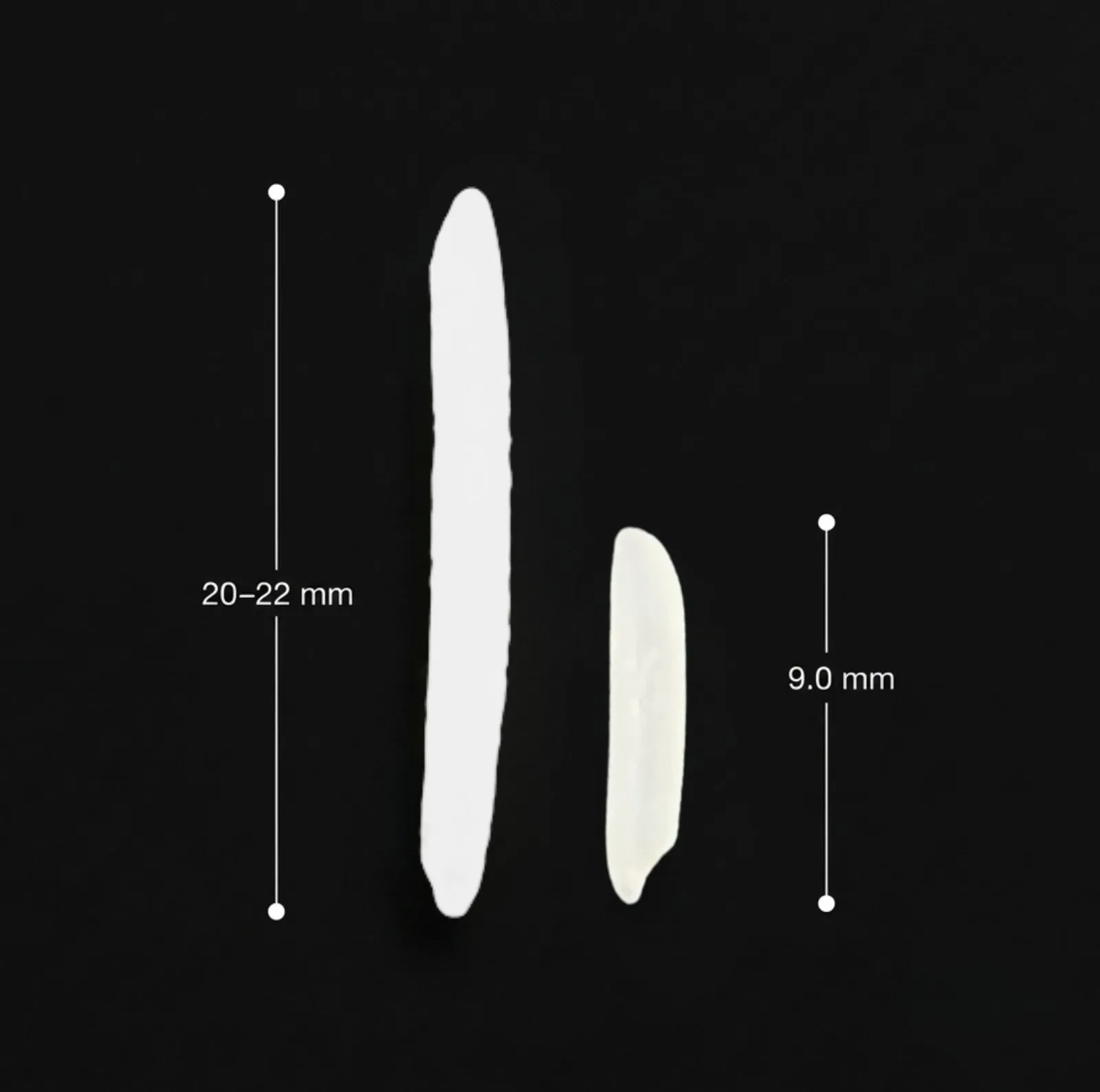
Raw 1121 measures about 8.3 mm on the caliper. Cooked, the same grain runs 18 to 22 mm, which is the length a buyer sees on the plate. A short grain barely moves.